


 Cart
Cart
 sales@molnova.com



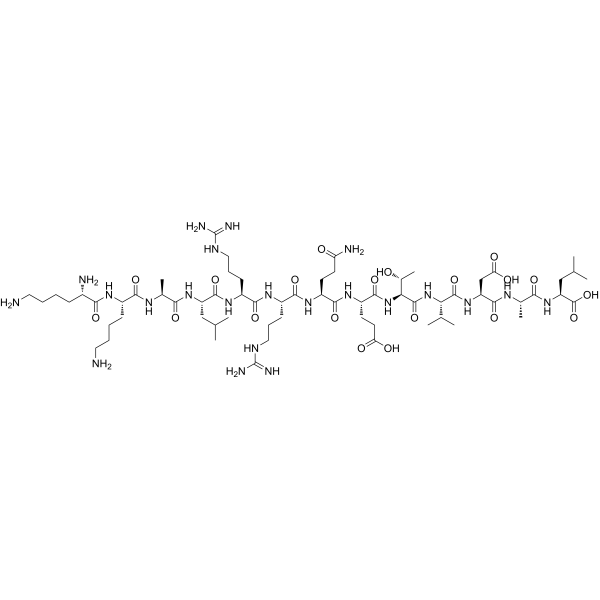
Autocamtide 2
CAS No. 129198-88-5
Autocamtide 2( Autocamtide II )
Catalog No. M29916 CAS No. 129198-88-5
Autocamtide-2 is a highly selective peptide substrate for calcium/calmodulin-dependent protein kinase II (CaMKII), which belongs to the CAMK Ser/Thr protein kinase family.
Purity : >98% (HPLC)
 COA
Datasheet
HNMR
HPLC
MSDS
Handing Instructions
COA
Datasheet
HNMR
HPLC
MSDS
Handing Instructions
| Size | Price / USD | Stock | Quantity |
| 5MG | 320 | Get Quote |


|
| 100MG | Get Quote | Get Quote |
|
| 200MG | Get Quote | Get Quote |
|
| 500MG | Get Quote | Get Quote |
|
Biological Information
-
Product NameAutocamtide 2
-
NoteResearch use only, not for human use.
-
Brief DescriptionAutocamtide-2 is a highly selective peptide substrate for calcium/calmodulin-dependent protein kinase II (CaMKII), which belongs to the CAMK Ser/Thr protein kinase family.
-
DescriptionAutocamtide-2 is a highly selective peptide substrate for calcium/calmodulin-dependent protein kinase II (CaMKII), which belongs to the CAMK Ser/Thr protein kinase family.(In Vitro):The Ca/calmodulin dependent protein kinases (CaMKs) are multifunctional serine/threonine kinases whose activity are regulated through Ca2+ signaling. It is multifunctional best known for its critical role in learning and memory. Recent studies demonstrates that high levels of different isoform of CaMK, especially for CaMKII, expresses in several cancers such as lung, breast, prostate and colon cancer. CaMKII phosphorylates nearly 40 different proteins, including enzymes, ion channels, kinases, and transcription factors and plays a critical role in the regulation of proliferation, differentiation and survival of various cancer cells.
-
In VitroThe Ca/calmodulin dependent protein kinases (CaMKs) are multifunctional serine/threonine kinases whose activity are regulated through Ca2+ signaling. It is multifunctional best known for its critical role in learning and memory. Recent studies demonstrates that high levels of different isoform of CaMK, especially for CaMKII, expresses in several cancers such as lung, breast, prostate and colon cancer. CaMKII phosphorylates nearly 40 different proteins, including enzymes, ion channels, kinases, and transcription factors and plays a critical role in the regulation of proliferation, differentiation and survival of various cancer cells.
-
In Vivo——
-
SynonymsAutocamtide II
-
PathwayOthers
-
TargetOther Targets
-
Recptor——
-
Research Area——
-
Indication——
Chemical Information
-
CAS Number129198-88-5
-
Formula Weight1527.77
-
Molecular FormulaC65H118N22O20
-
Purity>98% (HPLC)
-
SolubilityH2O : 20 mg/mL (13.09 mM; Need ultrasonic)
-
SMILES——
-
Chemical NameSequence:Lys-Lys-Ala-Leu-Arg-Arg-Gln-Glu-Thr-Val-Asp-Ala-Leu
Shipping & Storage Information
-
Storage(-20℃)
-
ShippingWith Ice Pack
-
Stability≥ 2 years
Reference



-
Pulsatilla saponin D
Pulsatilla saponin D has exhibited potential beneficial effects as a chemopreventive agent for critical health conditions including cancer and it inhibits cell growth via cell cycle arrest and apoptosis in various cancer cell types.
-
N'-Methylnicotinamid...
N-methylnicotinamide is a metabolite of niacin (or nicotinamide) and is commonly found in human urine. However low levels of urinary excretion of N-methylnicotinamide indicates niacin deficiency. In patients with liver cirrhosis nicotinamide methylation is increased leading to a rise in urinary N-methylnicotinamide. N-methylnicotinamide has been found to be a microbial metabolite.
-
(S,R,S)-AHPC TFA
(S,R,S)-AHPC TFA (VH032-NH2 TFA) is the VH032-based VHL ligand used in the recruitment of the von Hippel-Lindau (VHL) protein.
